Showing posts with label teaching_teachers. Show all posts

I Teach

National Education Association president Lily Eskelsen García explains the vital work of public school teachers at the Campaign for America's Future Awards Gala October 27, 2015 in Washington, where she received on one of the organization's Progressive Champion awards.


THE BEST THING ANYBODY SAID IN 2015: What teachers actually do all day.
Posted by INSIDER on Friday, January 1, 2016


Noam Chomsky infographic

Many thanks to David, 2nd-year Infant Education student for the tip:

 Primal Spring: Noam Chomsky: What does Noam Chomsky think about the Language Acquisition Device (LAD), Universal Grammar?


Do Schools Kill Creativity?

I can't believe I haven't posted this talk before. I first watched Do Schools Kill Creativity several years ago so I have no excuse other than everyone was blogging about it by then.

In this famous worldwide talk, Ken Robinson makes an entertaining and profoundly moving case in this talk for creating an education system that nurtures (rather than undermines) creativity. 


Watch the video and answer the following questions on twitter. Use this hashtag: #KenRobinsonTalk

- Who is Sir Ken Robinson? Where was he born? Why is he famous?
- What is TED Talks? What does TED stand for? What is its slogan?
- When was this talk given?

Growth Mindset

From http://thelearninglair.weebly.com/class-blog/growth-mindset-in-56s

From Jackie Gerstein's Pinterest Board Growth versus Fixed Mindset

To help you understand a little more about Growth Mindset, watch the short clip below and take a look at the poster above.


Noam Chomsky on Language Acquisition

Massachusetts Institute of Technology (MIT) linguist Noam Chomsky put forward the theory of the language acquisition device in the 1950s.


Chomsky argues that human brains have a language acquisition device (LAD), an innate mechanism or process that allows children to develop language skills. According to this view, all children are born with a universal grammar, which makes them receptive to the common features of all languages. Because of this hard-wired background in grammar, children easily pick up a language when they are exposed to its particular grammar.

Evidence for an innate human capacity to acquire language skills comes from the following observations: 

  • The stages of language development occur at about the same ages in most children, even though different children experience very different environments. 
  • Children’s language development follows a similar pattern across cultures.
  • Children generally acquire language skills quickly and effortlessly. 
  • Deaf children who have not been exposed to a language may make up their own language. These new languages resemble each other in sentence structure, even when they are created in different cultures.
Source: http://goo.gl/L0igr9

My school & my students. Photo Collage

Every year the Infant Education students prepare a theatre play for little children. 2 year olds from a Preschool nearby visit our Vocational school in order to participate in the activities prepared by 2nd year students. They produce a theatrical show and some more engaging activities. 1st year education students are usually in charge of school and classroom decorations. They also have to look after the children on their way to our school. Below you can see some pictures showing part of the project.


The Book with No Pictures

I had to post this video I came across with a few minutes ago on twitter. It is from one of my all time favourite sites for EFL/ ESL teachers http://community.eflclassroom.com/video/boo-boo-butt

Store 
Find more videos like this on EFL CLASSROOM 2.0

Message for students

Message for my students Via Emily Onken on Twitter https://twitter.com/EmilyOnken 

 Do you agree?


Fixed vs Growth Minsdet


Can intelligence grow or is it fixed and static?
Listen to the podcast below and complete the activities below.


Learning Theories & Teaching Methods I


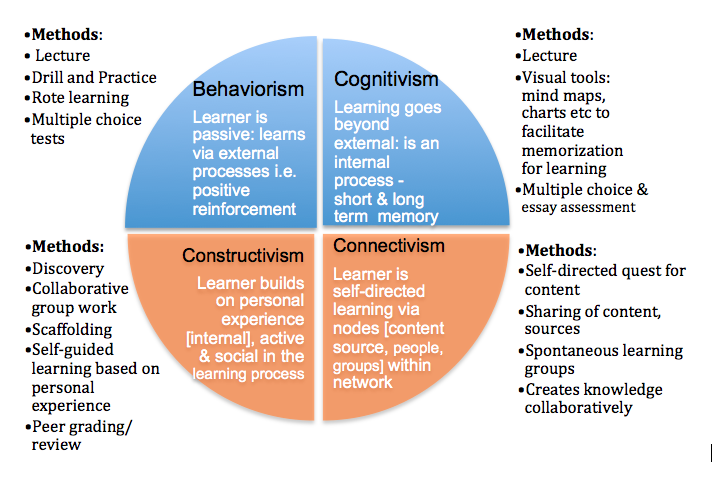
The image below shows four perspectives on learning based upon theoretical principles. Instructional methods associated with each, adjacent to respective quadrant. Orange quadrants represent a student-focused learning approach, blue instructor-focused.

Source: https://onlinelearninginsights.wordpress.com/tag/constructivism/


The Montessori Method

Visit also previous post on Learning Theories Education-through-Natural-Learning-Infographic
Find more education infographics on e-Learning Infographics
Top 100 web 2.0 Tools for Education chosen by Raul Diego, a higly connected  Spanish Primary teacher. 

How many tools do you use on a regular basis? 

21st Century Pedagogy


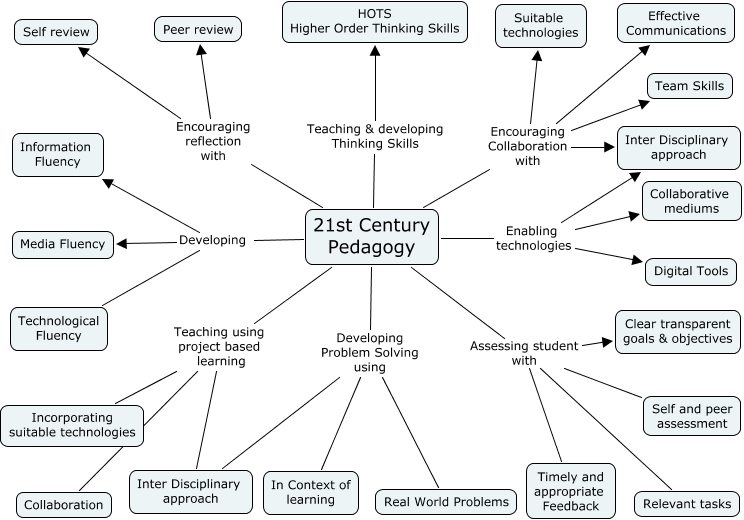
What is 21st Century Pedagogy?

I've come across two excellent and clarifying blogposts that will certainly bring some light to the new paradigm. New? Well, sort of.

http://www.teachthought.com/technology/a-diagram-of-21st-century-pedagogy/

http://edorigami.edublogs.org/2008/08/16/21st-century-pedagogy/


21st Century Teachers


The image below describes  the Connected Teaching Approach. 
In a connected teaching model, connection replaces isolation. Classroom educators are fully instrumented, with 24/7 access to data about student learning and analytic tools that help them act on the insights the data provide. Educators are connected to their students and to professional content, resources, and systems that empower them to create, manage, and assess engaging and relevant learning experiences for students both in and outside school. They also are connected to resources and expertise that improve their own instructional practices and that guide them in becoming facilitators and collaborators in their students’ increasingly self-directed learning.
In connected teaching, teaching is a team activity. Individual educators build online learning communities consisting of their students and their students’ peers; fellow educators in their schools, libraries, and afterschool programs; professional experts in various disciplines around the world....


source: http://www.flickr.com/photos/langwitches/3458534773/

Connected teaching also enables our education system to provide access to effective teaching and learning resources where they are not otherwise available and provide more options for all learners at all levels. This is accomplished by augmenting the expertise and competencies of specialized and exceptional educators with online learning systems and through on-demand courses and other self-directed learning opportunities.
The technology that enables connected teaching is available now, but not all the conditions necessary to leverage it are. Many of our existing educators do not have the same understanding of and ease with using technology that is part of the daily lives of professionals in other sectors and with this generation of students. The same can be said of many of the education leaders and policymakers in schools, districts, and states, and of the higher education institutions that prepare new educators for the field. This gap in technology understanding influences program and curriculum development, funding and purchase decisions about educational and information technology in schools, and pre-service and in-service professional learning. Too often, this gap prevents technology from being used in ways that would improve instructional practices and learning outcomes.

http://www.ed.gov/technology/draft-netp-2010/principles-connected-teaching
Related Posts Plugin for WordPress, Blogger...