

Showing posts with label learning. Show all posts
Showing posts with label learning. Show all posts




Learning Theories & Teaching Methods I

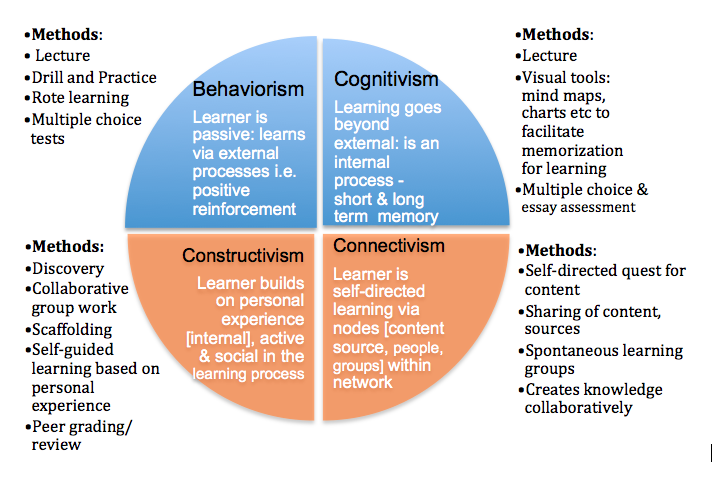
The image below shows four perspectives on learning based upon theoretical principles. Instructional methods associated with each, adjacent to respective quadrant. Orange quadrants represent a student-focused learning approach, blue instructor-focused.
Source: https://onlinelearninginsights.wordpress.com/tag/constructivism/
The Montessori Method
Visit also previous post on Learning Theories

Find more education infographics on e-Learning Infographics
Find more education infographics on e-Learning Infographics
21st Century Teachers
The image below describes the Connected Teaching Approach.
In a connected teaching model, connection replaces isolation. Classroom educators are fully instrumented, with 24/7 access to data about student learning and analytic tools that help them act on the insights the data provide. Educators are connected to their students and to professional content, resources, and systems that empower them to create, manage, and assess engaging and relevant learning experiences for students both in and outside school. They also are connected to resources and expertise that improve their own instructional practices and that guide them in becoming facilitators and collaborators in their students’ increasingly self-directed learning.
In connected teaching, teaching is a team activity. Individual educators build online learning communities consisting of their students and their students’ peers; fellow educators in their schools, libraries, and afterschool programs; professional experts in various disciplines around the world....

source: http://www.flickr.com/photos/langwitches/3458534773/
Connected teaching also enables our education system to provide access to effective teaching and learning resources where they are not otherwise available and provide more options for all learners at all levels. This is accomplished by augmenting the expertise and competencies of specialized and exceptional educators with online learning systems and through on-demand courses and other self-directed learning opportunities.
The technology that enables connected teaching is available now, but not all the conditions necessary to leverage it are. Many of our existing educators do not have the same understanding of and ease with using technology that is part of the daily lives of professionals in other sectors and with this generation of students. The same can be said of many of the education leaders and policymakers in schools, districts, and states, and of the higher education institutions that prepare new educators for the field. This gap in technology understanding influences program and curriculum development, funding and purchase decisions about educational and information technology in schools, and pre-service and in-service professional learning. Too often, this gap prevents technology from being used in ways that would improve instructional practices and learning outcomes.
http://www.ed.gov/technology/draft-netp-2010/principles-connected-teaching
Skills & Attributes of Today's Learner
Most of my students are a bit reluctant to use technology as a tool for sharing their learning experience. That makes me wonder Are they really learning after all?
I have tried very hard to make them understand the basics of digital literacy with very positive feedback.
In general terms, most of them probably lack many of the skills described in the picture below so I'm afraid perhaps it's a little too late to start to use critical thinking and problem-solving skills to tackle tough questions, or simply collaborate across networks (online and in-person).
Source: Edudemic
In any case I recommend this other blogpost from User Generated Education on the same topic: The Other 21st Century Skills of Modern Learners

I have tried very hard to make them understand the basics of digital literacy with very positive feedback.
In general terms, most of them probably lack many of the skills described in the picture below so I'm afraid perhaps it's a little too late to start to use critical thinking and problem-solving skills to tackle tough questions, or simply collaborate across networks (online and in-person).
Source: Edudemic
In any case I recommend this other blogpost from User Generated Education on the same topic: The Other 21st Century Skills of Modern Learners

How to Write Correctly in English
Writing is one of the most critical English language skills and many English learners struggle with writing error-free sentences.


If you still find writing a few sentences (or a blogpost) really difficult, you can always try this websites below.
http://virtualwritingtutor.com/
Or you can click on this link and correct some common mistakes on your own. Hope you enjoy it.
Last but not least, you can find a few more resources in your teacher's wiki.
The Key to Success is...
What’s the best predictor of success in a person’s life, including when it comes to goals in education? “Grit,” says psychologist Dr. Angela Lee Duckworth.
Dr. Angela Lee Duckworth is an assistant professor of psychology at the University of Pennsylvania. Angela studies non-IQ competencies, including self-control and grit, that predict success both academically and professionally. Watch this short video, it's a fascinating talk for everyone.
So what is grit? Find out in her TED Talk, in which Duckworth explains that grit is a better indicator of personal success than IQ, family income and other factors. Take the grit test yourself.
Dr. Angela Lee Duckworth is an assistant professor of psychology at the University of Pennsylvania. Angela studies non-IQ competencies, including self-control and grit, that predict success both academically and professionally. Watch this short video, it's a fascinating talk for everyone.
So what is grit? Find out in her TED Talk, in which Duckworth explains that grit is a better indicator of personal success than IQ, family income and other factors. Take the grit test yourself.
Theories of Learning
A brief overview of theoretical perspectives, learning theory, and instructional theory.
The video covers:
Behaviorism
Cognitivism
Constructivism
2. Types of learning theories:
An infographic from http://edudemic.com/

The video covers:
- Learning Theories:
2. Types of learning theories:
- Descriptive theories
- Prescriptive theories
An infographic from http://edudemic.com/

Subscribe to:
Posts (Atom)
