Massachusetts Institute of Technology (MIT) linguist Noam Chomsky put forward the theory of the language acquisition device in the 1950s.
Chomsky argues that human brains have a language acquisition device (LAD), an innate mechanism or process that allows children to develop language skills. According to this view, all children are born with a universal grammar, which makes them receptive to the common features of all languages. Because of this hard-wired background in grammar, children easily pick up a language when they are exposed to its particular grammar. Evidence for an innate human capacity to acquire language skills comes from the following observations:
The stages of language development occur at about the same ages in most children, even though different children experience very different environments.
Children’s language development follows a similar pattern across cultures.
Children generally acquire language skills quickly and effortlessly.
Deaf children who have not been exposed to a language may make up their own language. These new languages resemble each other in sentence structure, even when they are created in different cultures.
Theories of learning that helped change teaching methodologies developed by six remarkable educational theorists and researchers, namely Lev Vygotsky, Jean Piaget, Jerome Bruner, Benjamin Bloom, Erik Erikson and Howard Gardner.
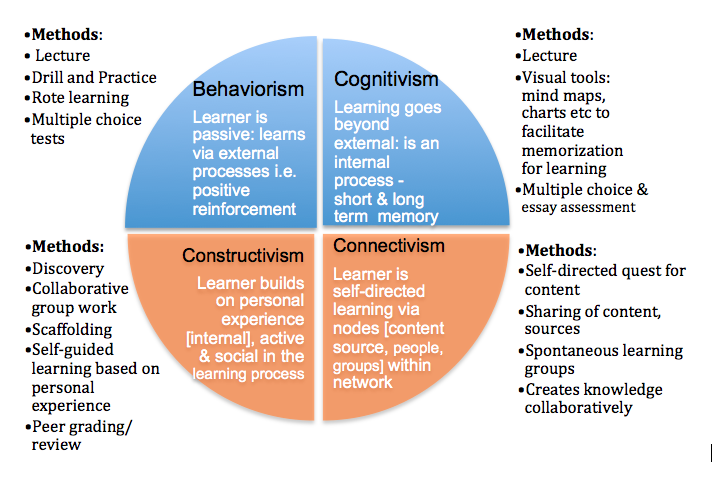
The image below shows four perspectives on learning based upon theoretical principles. Instructional methods associated with each, adjacent to respective quadrant. Orange quadrants represent a student-focused learning approach, blue instructor-focused. Source: https://onlinelearninginsights.wordpress.com/tag/constructivism/