
Showing posts with label pronunciation. Show all posts
Showing posts with label pronunciation. Show all posts

Online Games for EFL students
Revision
Flash Games
Free Online Games
Let's Have Fun With English Videos, games, interactive books...

Grammar Games:
Flash Games
Free Online Games
Let's Have Fun With English Videos, games, interactive books...

Grammar Games:
Pronunciation Tips via Phonics & IPA

The International Phonetic Alphabet, or IPA in short, can help you learn how to pronounce correctly each and every word in English! First, you need to learn what it is, and how to use it. Watch the video below and answer the questions in the end to test your understanding.

- How many sounds (more or less) are there in the English language?
What is the IPA?
How can the IPA help you?
What is a vowel?
What is a diphthong?
What is a consonant?
Really Learn English Pronunciation Lessons

Why is English Spelling So Weird?
My Vocational students, most of them young adults, are always complaining about the difficulties they encounter when dealing with the English pronunciation and spelling. It's not part of the vocational modules to go into the reasons why English spelling is so tricky but this video may help them to better understand the issue though it may be not enough to improve it.
The Unknown Rules of English Pronunciation

Source: http://www.readinghorizons.com/blog/post/2012/04/18/the-unknown-rules-of-the-english-language.aspx
Pronunciation Tips
Trying to speak like a native is almost impossible unless you were raised in a bilingual environment. The point is that good pronunciation is essential for speaking and also for understanding spoken English well.
I have compiled a series of videos hoping they can help you improve your pronunciation in English. Hope you enjoy the ride!
I have compiled a series of videos hoping they can help you improve your pronunciation in English. Hope you enjoy the ride!
Create your own Playlist on LessonPaths!
Consonants & Vowels Point of Articulation
In articulatory phonetics, the place of articulation (also point of articulation) of a consonant is the point of contact where an obstruction occurs in the vocal tract between an articulatory gesture, an active articulator (typically some part of the tongue), and a passive location (typically some part of the roof of the mouth). Along with the manner of articulation and the phonation, this gives the consonant its distinctive sound.


The International Phonetic Alphabet recognises the following places of articulation (among others):
| Bilabial | The point of maximum constriction is made by the coming together of the two lips. |
| Labiodental | The lower lip articulates with the upper teeth. |
| Dental | The tip of the tongue articulates with the back or bottom of the top teeth. |
| Alveolar | The tip or the blade of the tongue articulates with the forward part of the alveolar ridge. A sound made with the tip of the tongue here is an apico-alveolar sound; one made with the blade, a lamino-alveolar. |
| Postalveolar | The tip or the blade of the tongue articulates with the back area of the alveolar ridge. |
| Palatal | The front of the tongue articulates with the domed part of the hard palate. |
| Velar | The back of the tongue articulates with the soft palate. |
| Uvular | The back of the tongue articulates with the very back of the soft palate, including the uvula. |
| Pharyngeal | The pharynx is constricted by the faucal pillars moving together (lateral compression) and, possibly, by the larynx being raised. "It is largely a sphincteric semi-closure of the oro-pharynx, and it can be learned by tickling the back of the throat, provoking retching" (Catford 1978:163). |
| Glottal | The vocal folds are brought together; in some cases, the function of the vocal folds can be part of articulation as well as phonation, as in the case of [ ] and [h] in many languages. ] and [h] in many languages. |
Sources:
http://www.phon.ox.ac.uk/jcoleman/PLACE.htm
http://en.wikipedia.org/wiki/Place_of_articulation
When Two Vowels Go Walking
When Two Vowels Go Walking the First One Does the Talking is one of the easiest rule of English Pronunciation. Keep it in mind and don't forget.

Click on the following link so that you can listen to another cute version by Starfall

Click on the following link so that you can listen to another cute version by Starfall
English Pronunciation Again
The Lucy Show is an American sitcom that aired on CBS from 1962-68. It was Lucille Ball's follow-up to I Love Lucy.
Ball won consecutive Emmy Awards as Outstanding Lead Actress in a Comedy Series for the series' final two seasons, 1966-67 and 1967-68.
You should watch the video clip below. Quite funny it also illustrates some of the accent prejudices and some of the more confusing elements of English spelling and pronunciation.
Task: Note down all the words the husband mispronounces and also the ones you find shocking or worth sharing.
Pronunciation: Linking Sounds & Connected Speech
Pronouncing larger chunks of language is one of the biggest problems my students face every single day.
Definition of chunk: Several words that commonly occur together in fixed phrases sometimes referred to as a lexical phrase. We tend to speak in chunks which reduces the energy required for processing language.
For that matter I suggest practising linking sounds and connected speech.

When we speak naturally we do not pronounce words in isolation. Fluent speech flows with a rhythm and the words bump into each other. To make speech flow smoothly the way we pronounce the end and beginning of some words can change depending on the sounds at the beginning and end of those words. These changes are described as features of connected speech.
We link words ending with a vowel sound to words beginning with a vowel sound
Linking sounds por luizotaviobarros no Videolog.tv.
Sources:
http://www.bbc.co.uk/worldservice/learningenglish/grammar/pron/features/connected.shtml
http://www.englishclub.com/pronunciation/linking.htm
Definition of chunk: Several words that commonly occur together in fixed phrases sometimes referred to as a lexical phrase. We tend to speak in chunks which reduces the energy required for processing language.
For that matter I suggest practising linking sounds and connected speech.

When we speak naturally we do not pronounce words in isolation. Fluent speech flows with a rhythm and the words bump into each other. To make speech flow smoothly the way we pronounce the end and beginning of some words can change depending on the sounds at the beginning and end of those words. These changes are described as features of connected speech.
Connected Speech explained in Spanish with activities and examples.
Linking is a way of joining the pronunciation of two words so that they are easy to say and flow together smoothly. Linking is very important in English. If you recognize and use linking, two things will happen:
- you will understand other people more easily
- other people will understand you more easily
There are basically three types of linking:
- Consonant to Vowel
When a word ends in a consonant sound, we often move the consonant sound to the beginning of the next word if it starts with a vowel sound.
For example, in the phrase "turn off":
| We write it like this: | turn | off |
| We say it like this: | tur | noff |
Remember that it's the sound that matters. In the next example, "have" ends with:
- the letter "e" (vowel)
- the sound "v" (consonant)
So we link "have" to the next word "a" which begins with a vowel sound:
| We write it like this: | Can I have a bit of egg? |
| We say it like this: | Ca-nI-ha-va-bi-to-fegg? |
- Vowel to Vowel
When one word ends with a vowel sound and the next word begins with a vowel sound, we link the words with a sort of W or Y sound.
If our lips are round at the end of the first word, we insert a W sound:
| |||||||||||
If our lips are wide at the end of the first word, we insert a Y sound:
|
- Linking 'r'
In standard British English the letter 'r' after a vowel sound at the end of word is often not pronounced, as you can see in the image below,. However, when the following word begins with a vowel the /r/ sound is pronounced to make a smooth link.
 |
| http://linkingphonetics.wordpress.com/category/linking-r/ |
Linking sounds por luizotaviobarros no Videolog.tv.
Sources:
http://www.bbc.co.uk/worldservice/learningenglish/grammar/pron/features/connected.shtml
http://www.englishclub.com/pronunciation/linking.htm
Five Fatal mistakes in English
Five Fatal Mistakes in English Usage
More PowerPoint presentations from Rosa

THE SOUNDS OF ENGLISH (BBC tutorial, videos & quizzes)
The alphabet: phonemes (2 exercises)
Where is the primary tonic stress?

The Sounds of English
Strange but true, the alphabet with 26 letter does not represent all the sounds of English. There are 15 vowel and semi-vowel sounds and 23 consonant sound so do the math. I hope this video will clarify a little what you already know about English pronunciation, one of the trickiest in Europe.
Just as important as the learning of the English sounds is to deal with stress and intonation patterns.
Just as important as the learning of the English sounds is to deal with stress and intonation patterns.
How to Improve Oral Communication Skills
How to Improve your English Speaking & English Pronunciation Skills

“If you are NOT WILLING to learn, no one can help you. If you are DETERMINED to learn, no one can stop you.” –Anonymous

Resulta curioso leer en otros blogs de profes de inglés los mismos consejos y las mismas sugerencias que una lleva años repitiendo en clase.
Seguro que los enlaces que comparto abajo os sirven de ayuda para mejorar las destrezas comunicativas en general y la pronunciación en particular.
El Blog para Aprender Inglés
5 Characteristics to English Fluency

*Post in progress
Hello I am Germán, not German
Meet Germán, a Chilean youtubber, who has more than 9 million subscribers and 413 million views.
Hola Soy German (Hello I Am German) is the YouTube channel of German Garmendia, a 22-year-old comedian in Chile who has imported this video genre to a Spanish-language audience.
Phonemic Charts

The phonemic chart contains all 44 sounds of Received Pronunciation that make up words in spoken English. It's very useful for studying English pronunciation, as it's the one used by most dictionaries.
International Phonetic Alphabet (IPA)
Origin
The IPA was first published in 1888 by the Association Phonétique Internationale (International Phonetic Association), a group of French language teachers founded by Paul Passy. The aim of the organisation was to devise a system for transcribing the sounds of speech which was independent of any particular language and applicable to all languages.
A phonetic script for English created in 1847 by Isaac Pitman and Henry Ellis was used as a model for the IPA.
Uses
- The IPA is used in dictionaries to indicate the pronunciation of words.
- The IPA has often been used as a basis for creating new writing systems for previously unwritten languages.
- The IPA is used in some foreign language text books and phrase books to transcribe the sounds of languages which are written with non-latin alphabets. It is also used by non-native speakers of English when learning to speak English.
Do you really need all this? Yes, you do, but don't worry too much, you won't be asked to learn the phonetic chart by heart.
Let's Get Serious About Pronunciation


Unstressed Syllables and Schwa /ə/
Within a multi-syllable word, an unstressed syllable is frequently located next to a stressed syllable. Often, this vowel sound is not phonetic (not pronounced the way it is spelled), and is instead pronounced with a quick, neutral vowel sound called schwa. Because schwa is a function of syllable stress and not spelling, schwa can have almost any spelling.
In dictionary transcriptions, the vowel sound scwha is represented with an upside-downe: /ə/.
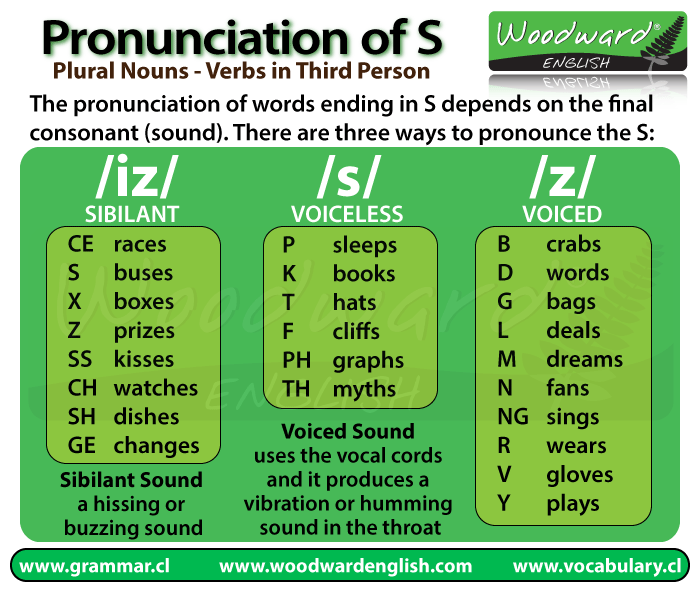

| 1) The 3 different ways of pronouncing the final ED of regular verbs |
| 2) Practising (listening & writing activities) and phonetic rules |
| 3) Exception: some adjectives ending in ED |
22 Maps that Show the Deepest Linguistic Conflicts in-America
The regional accents of English speakers show great variation across the areas where English is spoken as a first language. This article provides an overview of the many identifiable variations in pronunciation, usually deriving from the phoneme inventory of the local dialect, of the local variety of Standard English between various populations of native English speakers.

American Accents Overview
open/close all folders
Dixie
Floridian
Miamian
Hillbilly/Appalachian
Texas Drawl
Cajun
Yat
Tidewater/Mid-Atlantic
Urban
Noo Yawk
Joisey/Da Bronx
Prep
The Affect
Northeastern/Puerto Rican AKA Nuyorican
Jewish
Luso
Down East
Vermon
Boston
Pittsburgh
Philly
Pennsylvania Dutch
Baltimorean
Midwestern
Inland North
North Midland
Michigan
Upper Midwest
Cowpoke
Jello Belt
Californian
Valley Girl (California)
Surfer Dude (California)
Nor Cal (California)
Pasadena (California)
Latino (California)
Pacific Northwestern
Hawai'i Pidgin


Subscribe to:
Posts (Atom)
